 Italiano
 English
 简体中文
 Español
 Français
 Deutsch
 Português
 Nederlands
 Polski
 Svenska
 Русский
 Українська
 Türkçe
 العربية
 हिन्दी
 বাংলা
 日本語
 한국어
 Bahasa Indonesia
 Bahasa Melayu
 Tiếng Việt
 ไทย
 Filipino
Buying wholesale trash bags involves more than choosing a capacity and comparing prices. Importers, distributors, and private-label buyers need products that fit local bins, perform consistently, and arrive in packaging suited to their sales channels. A clear specification makes supplier quotations easier to compare and helps prevent costly misunderstandings.
Build Your Range Around the Bins Customers Use
Start with your destination market and customer base. Household retailers, office suppliers, and cleaning-product distributors may need different sizes and closure styles. Capacity labels alone are not enough: a tall, narrow bin and a short, wide bin can hold the same volume but require different liners.
Specify bag width and length, clarify whether dimensions include gussets, and allow enough material to fold over the rim and close the filled bag. A compact range of clearly differentiated sizes is often easier to manage than many overlapping products.
Compare Material, Strength, and Seals Together
HDPE can suit some lightweight, relatively dry waste applications, while LDPE and LLDPE-based films may be considered where flexibility and toughness matter. Performance depends on the formulation, thickness, manufacturing process, and bag construction.
State thickness in a defined unit. One mil equals 25.4 microns; the meaning of “gauge” should be confirmed with the supplier. For meaningful price comparisons, align dimensions, thickness tolerances, material requirements, and bag count. Evaluate seal integrity as well as the film itself.
Specify Packaging for Your Sales Channel
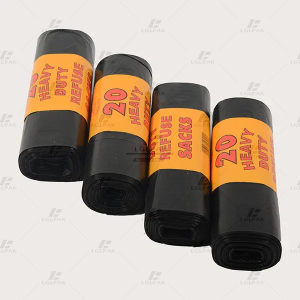
Wholesale trash bags may be sold on rolls, in retail packs, or in cartons for professional users. Define bags per roll, rolls per pack, packs per carton, and any labeling or barcode requirements. Check perforations and dispensing during sample evaluation.
Retail buyers should review pack dimensions and shelf presentation. Importers should also confirm carton dimensions, gross weight, and the proposed shipping configuration before estimating landed cost.
Use Samples to Confirm the Buying Specification
Test samples in representative bins with typical waste. Check fit, opening, leakage under the intended conditions, and removal after loading. Record what passes and agree how production orders will be checked against the approved specification.
A sample is most useful when its dimensions and construction are documented.
Frequently Asked Questions
What should an RFQ for bulk trash bags include?
Include destination market, dimensions, material requirements, thickness and tolerance, color, closure, packaging, quantity, and delivery terms. State whether the quantity means individual bags, rolls, cartons, or weight.
How should buyers compare minimum order quantities?
Ask whether the MOQ applies per size, color, print design, or total order. Confirm sample costs and any setup charges separately so quotations cover the same scope.
Discuss Your Trash Bag Requirements with LGLPAK
LGLPAK is a packaging company producing trash bags and other plastic bag products. For your next sourcing project, visit www.lglpak.com and share your target sizes, packaging format, and order quantity. A clear brief is the starting point for discussing suitable supply options.